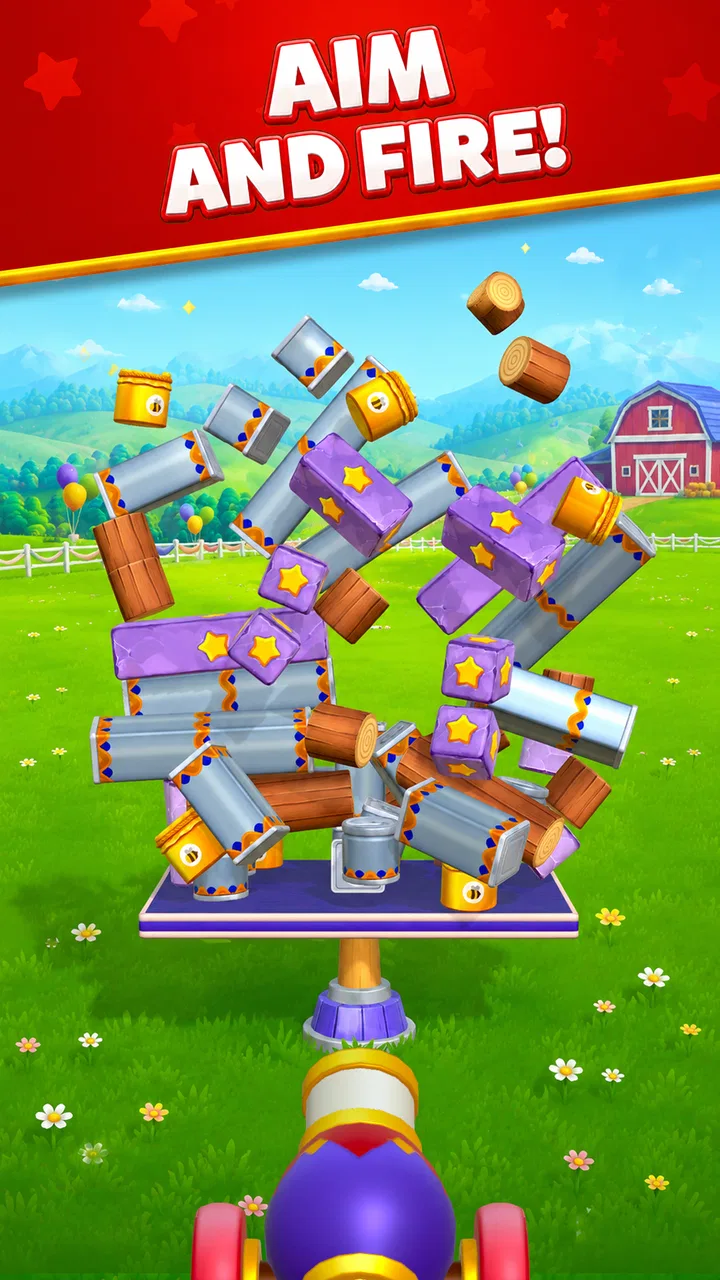
Stack Smash - Block 3D Puzzle
- 4.9
- Rating
- 1.00M
- Installs
- Free
- Price

 Analysis by App-foxy
I went into Stack Smash - Block 3D Puzzle expecting a quick stacking game, but its appeal is more thoughtful than the short name suggests. This is a free puzzle game from Tripledot Studios Limited built around arranging and smashing blocks in a three-dimensional space. The presentation is cute and relaxed, while the underlying challenge comes from judging position, balance, timing, and the order in which pieces should be handled.
That combination makes it easy to start and surprisingly difficult to master. I can play for a few minutes while waiting for coffee, yet the same simple-looking board can demand much more attention when the available space becomes awkward. It is not a story-driven game or a deep strategy title. Its strength is the small decision in front of me: where should this block go, and will that choice leave enough room for what comes next?
The game is free to install, carries an Everyone content rating, and has reached over a million installs. Its average rating is 4.9 from around 32 thousand ratings, which suggests that the compact puzzle format has found a receptive audience. The current version is 0.6.0, and it runs on devices using Android 7.1 or later. In-app purchases range from $1.99 to $99.99 per item, so the free entry point is attractive, but anyone who dislikes optional spending should still pay attention to the purchase flow.
You May Also Like

 Blood Strike: 2.5 Anniversary
Blood Strike’s Loadouts Turn Every Drop Into a Tactical Gamble
A close look at Blood Strike’s custom loadouts: how fast access to signature weapons reshapes its battle royale rhythm, rewards preparation, and narrows the gap between fights.

 Pandora - Music & Podcasts
Pandora’s Music Is Easy to Start, but Harder to Recover
Pandora’s strength is its low-effort path from a seed to a station. Its weak spot is how much confidence it asks you to place in connection, setup, and quiet recovery.

 8 Ball Pool
 Is Built on Rivalries, Rematches, and Routine
A close look at the rivalries, rematches, shared routines, and unanswered safety questions that turn a quick pool match into a persistent mobile community.

 Samsung Music
’s Quiet Strength Is Playing What You Already Own
Its reach comes less from spectacle than from dependable access to a personal library. That simplicity is both the app’s strongest retention engine and its ceiling.

 AccuWeather: Weather Radar
AccuWeather Review: A Quick, Clear Forecast for Everyday Decisions
For everyday plans, the best forecast is the one you can understand quickly. AccuWeather makes rain timing, radar, and local conditions easy to act on, with a few trade-offs.

 Hill Climb Racing
Why Hill Climb Racing Still Turns Crashes Into One More Run
A tiny car, a bumpy hill and one more upgrade: Hill Climb Racing keeps resurfacing because its simple chaos makes every near-miss feel personal.
More From Our News Desk



How the first goals shape the opening minutes
The opening experience works because the objective is immediately readable. I do not need a long explanation before making a move. Blocks occupy a shared space, and I am encouraged to stack them in a way that lets the structure survive long enough for the puzzle to resolve. The physical look of the pieces gives every placement a little weight; even when the action is simple, the result feels more tangible than tapping through a flat list of matching tiles.
Those early goals are useful because they teach the game through action rather than through a heavy tutorial. I quickly understand that a move can be locally correct but strategically poor. A block may fit perfectly in the moment and still create a narrow gap that makes the next placement harder. That is the first important lesson: the goal is not merely to place something, but to preserve a workable shape.
I found it helpful to slow down during the first few rounds instead of treating every move as a reflex action. When a piece appears, I look at the empty areas around the stack and consider which spaces are likely to become inaccessible. This habit is more valuable than trying to move quickly. The game rewards reading the board before committing, especially when a promising placement could hide a useful opening underneath.
The early structure also makes the game approachable for people who normally avoid puzzle titles. There is no need to memorize a complicated ruleset or learn a large collection of special abilities. A child can understand the basic aim, while an experienced puzzle player can start thinking about efficiency and future space almost immediately. That broad accessibility fits the Everyone rating without making the opening feel empty.
Why the physical presentation matters
The three-dimensional presentation is not just decoration. It changes how I read the puzzle. In a traditional two-dimensional grid, an empty square is easy to identify. Here, height and overlapping pieces can make a location appear available while actually being difficult to use. I have to judge the stack as a shape rather than as a collection of isolated cells.
That visual layer creates one of the game’s more interesting trade-offs. The cute style keeps the experience friendly, but the dimensional view can also make a crowded arrangement harder to parse. When I am unsure about a move, I do better by rotating my attention around the whole structure instead of focusing only on the most obvious open side. The game feels calmer when I treat each board as a small spatial problem rather than a speed test.
For a casual player, this means the first goals remain comfortable without being completely automatic. For a dedicated puzzle fan, the same simplicity provides room to optimize. I would not describe the opening as demanding, but it does establish the central skill clearly: build with the next few decisions in mind.
Progress signals and the feeling of moving forward
One of the more important questions for a puzzle game is whether each successful round feels meaningful. In my experience, Stack Smash communicates progress mainly through the act of solving and advancing, rather than through a complicated layer of narrative or character development. That suits the compact format. I know I have improved when I can keep a cleaner structure alive, recover from a less-than-perfect placement, or finish a puzzle without filling the board with unusable gaps.
The strongest progress signal is personal consistency. At first, I tend to celebrate any workable placement. After playing longer, I start noticing the difference between surviving a board and controlling it. I become more selective about where I put pieces, and I pay attention to how much flexibility remains after each move. That is a subtle form of advancement, but it is genuine: the game trains me to see consequences earlier.
Players looking for a large collection of visible unlocks may find the experience less satisfying than a puzzle game with extensive worlds, characters, or equipment. Stack Smash is more focused on repeated improvement within its core interaction. Its progress is felt through better decisions and completed challenges, not through an elaborate role-playing structure. That is a strength if I want a clean puzzle loop, but a limitation if I need constant external rewards.
I also appreciate that the game does not need a long session to provide a sense of completion. A short play period can still contain a clear beginning, a series of decisions, and a result. This makes it suitable for small breaks. I can put the phone away after a successful attempt without feeling that I abandoned a large ongoing campaign.
Practical ways to read the board better
My most useful approach is to protect flexibility rather than chase the most attractive open space. A wide, obvious gap is not always the best destination if filling it divides the remaining area into awkward pockets. I try to imagine how the stack will look after the piece settles, then ask whether the next placement will still have more than one reasonable option.
A second useful habit is to avoid building a tall, uneven structure too early unless the arrangement clearly benefits from it. Height can make the board visually impressive, but it may also reduce access to lower spaces. When several placements seem possible, I usually prefer the one that keeps the silhouette compact and leaves the greatest number of usable surfaces visible.
Finally, I treat a nearly full board as a planning problem rather than a reason to rush. The last few moves often expose whether earlier choices were sound. If I have preserved a clean route through the structure, the ending feels controlled. If I have created isolated pockets, the final stage becomes a scramble. This is where the game’s physics-puzzle identity becomes most noticeable.
Difficulty, challenge, and the pace of learning
The difficulty curve works best when I allow myself to learn from failed arrangements. The basic action remains approachable, but the consequences of poor positioning become clearer as the board grows more demanding. I do not need complex rules to feel pressure; limited space and awkward geometry are enough to make a familiar move suddenly risky.
What I like about this curve is that it gives the player a chance to develop judgment before demanding perfection. Early success comes from understanding the immediate objective. Later success depends on predicting how a placement will affect the remaining structure. That shift is gradual enough for casual play, yet meaningful enough to keep the puzzle from becoming a mindless stacking exercise.
The challenge is also more about spatial awareness than speed. I do not recommend playing with the mindset of a fast arcade game. Rushing can make a simple mistake more likely, particularly when the three-dimensional view hides a problem behind or beneath another block. Taking a moment to inspect the available space is not wasted time; it is part of the intended skill.
There is a trade-off here for players who prefer highly transparent logic puzzles. A conventional grid-based match game may be easier to analyze because every position is visually explicit. Stack Smash feels more tactile and physical, but that can occasionally make a failed attempt feel like a perception error rather than a purely logical mistake. I enjoy that ambiguity in moderation, although players who want perfectly predictable board states may prefer a more traditional puzzle format.
Who will enjoy the challenge most?
I think the best audience is someone who likes short spatial puzzles and does not mind repeating a core action while gradually improving. The game is particularly suitable for players who enjoy arranging objects, spotting future problems, and experimenting with safer placements. It also works well for families because the main idea is easy to explain without requiring advanced reading or specialist puzzle knowledge.
It is less suitable for someone seeking a large adventure, a strong narrative, or a broad collection of distinct game modes. The appeal comes from refining one central interaction. If I want a game that constantly introduces new characters, abilities, or story events, this is probably not where I would spend most of my time.
It may also frustrate players who dislike losing progress because of one poor spatial decision. The friendly visuals can make the game look gentler than it is. Once the structure becomes constrained, a small mistake can have consequences several moves later. I see that as a fair part of the challenge, but it is worth knowing before downloading.
Retention pressure and the cost of one more attempt
The game’s strongest retention tool is the desire to correct a mistake. When I fail, I usually understand enough about the board to identify what went wrong: I filled a useful opening too soon, built an unstable shape, or ignored a trapped area. That clarity creates a natural reason to try again. I am not replaying only because the game tells me to; I am replaying because I can see a better line of play.
This kind of pressure is healthier than a loop based entirely on noise and interruption. The puzzle itself supplies the tension. A successful attempt feels satisfying because it reflects improved planning, while a failed attempt can still teach me something. The risk is that repeated retries may become repetitive for players who need frequent novelty. The central mechanic has enough depth for practice, but it is still one central mechanic.
The free price makes experimenting easy. I can install the game without committing money, test whether the physical stacking feels comfortable on my device, and decide quickly whether the pacing suits me. The presence of in-app purchases means I would still encourage a careful approach to any optional spending. The game does not need a purchase for me to understand its basic appeal, so I would first play the free experience and only consider paying if the available option clearly improves my own use.
For an everyday scenario, I can see myself opening it during a short commute or while waiting for an appointment. I would play a few rounds, stop after a clean solution, and return later without needing to remember a complicated story. That low commitment is one of its practical strengths. On the other hand, if I were planning a long evening of gaming, I would probably combine it with a deeper puzzle title so the repeated stacking loop did not begin to feel too narrow.
How it compares with familiar puzzle alternatives
Compared with match-three games, Stack Smash asks for more spatial planning and less pattern scanning. I am not mainly hunting for a quick combination of identical symbols. I am managing volume, position, and access. Compared with classic falling-block games, it feels less focused on rapid reactions and more focused on deliberate placement. That makes it calmer, although players who enjoy constant speed escalation may find it less energetic.
It also differs from pure logic-grid puzzles. Those games often present a fixed set of abstract rules, while this one gives me a more physical object to manipulate. The advantage is immediacy: I can understand the board visually. The disadvantage is that depth perception and crowded shapes can sometimes make the challenge feel less exact. Choosing between them depends on whether I prefer tactile spatial judgment or formal deduction.
Against minimalist stacking games, the puzzle framing gives each placement more purpose. I am not simply trying to create the tallest structure. I am trying to preserve a useful arrangement and reach a successful resolution. That distinction is small but important, because it changes the way I think about risk. A visually impressive stack can still be a poor puzzle solution.
My progression verdict after settling into the loop
Stack Smash - Block 3D Puzzle succeeds when it keeps attention on the relationship between one move and the next. Its early goals are clear, its progress is mostly expressed through improving judgment, and its difficulty grows from increasingly demanding spatial decisions rather than from a complicated rulebook. The pacing is best for short sessions, repeated attempts, and players who enjoy seeing a failed arrangement turn into a better plan.
The game’s limitations are closely tied to its strengths. Its focused structure is approachable, but it may not provide enough variety for players who expect a large progression system. The three-dimensional presentation makes the puzzle distinctive, but it can also make crowded boards harder to read. Optional purchases are present, so I would approach them deliberately rather than assuming that every offer is necessary.
My practical recommendation is to give it a fair trial if you like calm puzzle games with a physical feel. Play slowly at first, protect open routes, and judge a move by the space it leaves behind rather than by how well it solves the immediate problem. Those habits reveal the game’s real depth much faster than rushing through the opening.
I would recommend it to a friend who wants a free, accessible puzzle for short breaks and enjoys improving through repetition. I would skip it in favor of a more elaborate alternative if I wanted story, extensive unlocks, or radically different activities from one session to the next. For the audience it targets, though, the most satisfying part is learning to see the whole stack before making the next move. That gives the cute presentation a worthwhile strategic core, and it is why I kept returning after an avoidable mistake.
FAQs for Stack Smash - Block 3D Puzzle
01What is Stack Smash - Block 3D Puzzle and how is it played?
Stack Smash - Block 3D Puzzle is a casual puzzle game focused on arranging and clearing blocks in a three-dimensional stack. The main objective is to place or match pieces carefully, create combinations, and remove layers before the board becomes difficult to manage. Its simple controls make it easy to start, while later levels require more planning and attention.
02Is Stack Smash - Block 3D Puzzle suitable for beginners?
Yes, the game is generally accessible to beginners because its core mechanics are straightforward and can be learned quickly through early levels. However, it is not completely effortless. As the puzzles become more complex, players need to think ahead, recognize useful combinations, and avoid filling important spaces too soon. It works well for short, casual play sessions.
03Does Stack Smash - Block 3D Puzzle require an internet connection?
The basic puzzle experience appears designed for offline-friendly casual play, which is convenient when you are traveling or have limited connectivity. Nevertheless, some features may depend on an internet connection, including advertisements, promotional rewards, updates, analytics, or other online services. For the most reliable experience, open the game once while connected and check which functions remain available offline.
04Are there advertisements or in-app purchases in Stack Smash - Block 3D Puzzle?
Like many free-to-download mobile puzzle games, Stack Smash - Block 3D Puzzle may include advertising and optional in-app purchases. Ads can potentially appear between levels or when claiming bonus rewards, while purchases may be offered for extra items, boosters, or an ad-free experience. Availability and pricing can vary by device, region, and version, so review the store listing before downloading.
05Is Stack Smash - Block 3D Puzzle safe to download and suitable for children?
The game should be downloaded through the official Google Play Store or Apple App Store to reduce the risk of modified or unsafe files. Parents should still review the current age rating, privacy information, advertising behavior, and purchase settings before allowing children to play. Because the game may encourage repeated attempts or optional spending, parental controls are recommended for younger users.
Pros
- Simple drag-and-drop controls are easy to learn.
- Short levels make it suitable for quick gaming sessions.
- 3D block visuals give the puzzle board a clear appearance.
- Increasing difficulty keeps later stages more engaging.
- Works well as a casual game for relaxing offline play.
Cons
- Some puzzles may feel repetitive after extended play.
- Progress can become slow without optional boosts or retries.
- Small boards may limit strategic variety in certain levels.
- Ads may interrupt the experience between completed puzzles.
- Players seeking competitive multiplayer features may find it limited.

Stack Smash - Block 3D Puzzle
Gallery